- Lou Stagner Golf
- Posts
- Lou Stagner's Newsletter #131
Lou Stagner's Newsletter #131
Hydration Might Be Costing You More Than You Think

Lou Stagner
March 27, 2026


Weekly Quiz!
To see correct answer, click “CONTINUE” button at the bottom of the next page.
Good luck! 😀
How often will the typical tour pro hit it inside 10 feet from 150 to 159 yards in the fairway? |
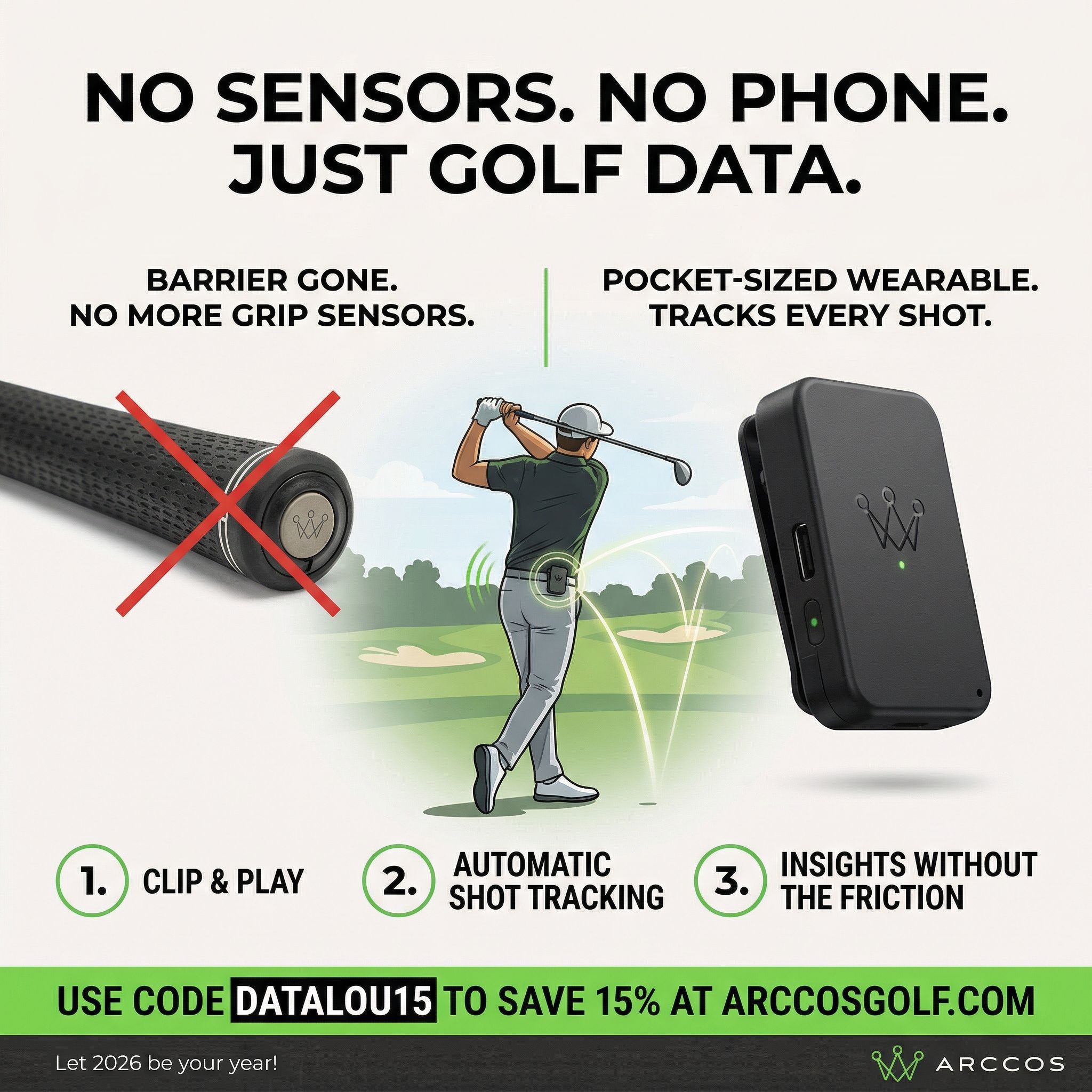
The New Arccos Air
The new Arccos Air dropped last week, and like I mentioned then, it’s a massive game-changer. Get all the powerful Arccos analytics with ZERO grip sensors and no phone in your pocket! Just clip on the wearable (or slip in your pocket) on and play. Let 2026 be your year.
Use code DATALOU15 to save 15% at arccosgolf.com.
Hydration Might Be Costing You More Than You Think
Earlier this week, an elite player I work with was talking to me about on-course nutrition and hydration. This is an important topic that most golfers pay zero attention to.
There is an interesting study titled Effect of Acute Mild Dehydration on Cognitive-Motor Performance in Golf by Mark F. Smith, Alex J. Newell, and Mistrelle R. Baker.
Golfers tend to think about hydration as a comfort issue. Was I thirsty? Did I feel tired? Did I get a headache? Was it hot out?
There is much more to it than that.
The Study
Smith, Newell, and Baker looked at seven low-handicap golfers and tested them in two states: hydrated and mildly dehydrated.
The dehydration protocol was simple. A 12-hour fluid restriction. That is essentially not drinking anything after dinner until the next morning.
This wasn't some extreme survival test. These players were only mildly dehydrated. On average, body mass dropped by about 1.5%. For a 200-pound golfer, that's about 3 pounds. You wouldn't even feel it.
That matters because a lot of golfers either start the round that way or drift into that range during a round without thinking much about it. Especially in heat. Especially when they walk. Especially when they're "too busy playing" to hydrate.
The players did two golf-specific tasks. First, they hit shots with a 9-iron, 7-iron, and 5-iron. Second, they completed a distance-judgment task where they estimated yardages to the flag.
What They Found
When players were dehydrated they hit the ball a lot worse. They were about a club shorter when dehydrated, and their offline dispersion was much worse, going from about 13'6" to 26 feet. They were likely making worse contact, and that worse contact was showing up as both shorter distances and a bigger miss pattern.
Their distance judgment got much worse. Average error in estimating distance to the target jumped from ~14 feet to nearly ~29 feet.
Why This Matters
A lot of golfers think hydration only becomes important once they "feel" dehydrated. That's probably too late.
By the time your focus is down, your energy is flat, and your yardages start getting fuzzy, the damage may already be showing up on the scorecard.
My Thoughts
This was a small study. Seven players under controlled testing. So we shouldn't pretend it answered every question about hydration in golf.
But I did remind us that even mild dehydration can affect the body and the brain in a game that depends heavily on both.
And that lines up with what many players have experienced even if they didn't label it correctly. "I just felt a little off." "I couldn't focus." "My numbers felt weird." "I wasn't sharp late in the round."
Maybe it wasn't your swing. Maybe it was your hydration.
Don't make hydration an afterthought. Show up hydrated. Start early. Sip during the round instead of trying to play catch-up later. And if you play in warm conditions or tend to sweat a lot, build a plan instead of winging it.
Finally...
Advertise your business to 38,000+ readers of this newsletter.
Shop Arccos Golf here. (Use code DATALOU15 to save 15%)
Join Team Titleist here.
Shop StrackaLine Green Books here. (Use code DATALOU15 to save 15%)
Listen to the “Hack it Out Golf” podcast on Apple or Spotify.
Submit ideas or feedback here.
Have a great week!
